

Series:
Living for God in a World that Has Forgotten Him
Daniel 9:1-19 KJV

The Book of Daniel
Lesson Nine
WHEN HEAVEN HEARS A HUMBLE HEART
The Prayer That Moved Heaven
Daniel 9:1–19 (KJV)
Daniel 9:1–19 teaches us that genuine revival begins when God’s people return to His Word and humble themselves in prayer. As Daniel studied the prophecy of Jeremiah, God’s promises moved him to repentance rather than complacency. His prayer was marked by humility, confession, and a deep concern for God’s glory instead of personal comfort. Rather than blaming others, Daniel identified with the sins of his nation and appealed solely to the mercy of God. His example reminds us that the Lord delights in hearing the prayers of humble, repentant hearts and that lasting spiritual renewal always begins on our knees before Him.
Daniel‘s Fourth Vision:
CHAPTER 9
The Vision of the Seventy weeks of years
| Approx. Date | Chapter | Ruler / Setting | Vision or Revelation |
| c. 603–602 B.C. | Daniel 2 | 2nd year of Nebuchadnezzar | Great Image — Four Gentile Kingdoms |
| c. 553 B.C. | Daniel 7 | 1st year of Belshazzar | Four Beasts, Little Horn & Son of Man |
| c. 551 B.C. | Daniel 8 | 3rd year of Belshazzar | Ram, He-Goat & Little Horn |
| 539 B.C. | Daniel 9 | 1st year of Darius the Mede | Seventy Weeks |
| 536 B.C. | Daniel 10–12 | 3rd year of Cyrus | Final Vision — Israel, Antichrist, Tribulation & Resurrection |
Daniel 7 specifically dates its vision to the first year of Belshazzar, while Daniel 10 places in the third year of Cyrus.
SEVENTY WEEKS
Daniel 9 — Approximately 539 B.C.
First year of Darius the Mede
Babylon has now fallen.
Daniel has been reading Jeremiah and realizes that the seventy-year Babylonian captivity is approaching its conclusion.
So Daniel begins praying.
And what a prayer!
He confesses his sins and the sins of Israel.
Then Gabriel comes with one of the most important prophetic revelations anywhere in Scripture:
Daniel 9:24 KJV — “Seventy weeks are determined upon thy people and upon thy holy city…”
THE SEVENTY WEEKS
70 weeks × 7 = 490 years
The prophecy particularly concerns:
“thy people” — Israel
and
“thy holy city” — Jerusalem.
Gabriel divides the period:
7 weeks = 49 years
62 weeks = 434 years
Together:
69 weeks = 483 years
Then:
Daniel 9:26 KJV — “…shall Messiah be cut off, but not for himself…”
This points prophetically to the rejection and death of Messiah.
Then Jerusalem and the sanctuary are destroyed.
Finally comes the remaining:
70th Week — seven years
Under the futurist interpretation, this final seven-year period is associated with the coming Tribulation and the activities of the coming prince/Antichrist, particularly the breaking of the covenant in the middle of the week.
Daniel 9:24–27 explicitly lays out the seventy weeks and the coming ruler associated with the final week.
This is one of Daniel’s great prophetic clocks.
And notice what started it:
Daniel was studying his Bible and praying.
Prophecy wasn’t given merely to satisfy curiosity about tomorrow. It drove Daniel toward prayer, confession, holiness and faithfulness today.
Prophetic truth: God’s prophetic clock centers upon Israel, Jerusalem, Messiah and God’s coming Kingdom.
One of the most important things to explain when teaching Daniel because the book is not arranged in strict chronological order.
Daniel 5 is usually placed at 539 BC, when Babylon fell to the Medes and Persians. Daniel 8 occurred earlier, around 551/550 BC, during Belshazzar’s third year.
A simple way to explain it:
Think of Daniel as being arranged by subject as well as by time.
| Chapter | Approx. Date | Event |
|---|---|---|
| Daniel 1 | 605 BC | Daniel taken to Babylon |
| Daniel 2 | 603/602 BC | Nebuchadnezzar’s image |
| Daniel 3 | During Nebuchadnezzar’s reign | Fiery furnace |
| Daniel 4 | During Nebuchadnezzar’s reign | Nebuchadnezzar humbled |
| Daniel 7 | 553 BC | Belshazzar’s 1st year |
| Daniel 8 | 551/550 BC | Belshazzar’s 3rd year |
| Daniel 5 | 539 BC | Babylon falls |
| Daniel 6 | After 539 BC | Daniel and the lions |
| Daniel 9 | 539/538 BC | First year of Darius |
Daniel 4 → Daniel 7 → Daniel 8 → Daniel 5 → Daniel 6 → Daniel 9.
Then why didn’t Daniel arrange them that way?
Because Daniel has a remarkable literary structure.
Daniel 1 introduces the whole book.
Then Daniel 2–7 forms a major section dealing especially with Gentile kingdoms and God’s sovereignty over them. Significantly, Daniel 2:4b through 7:28 is written primarily in Aramaic, the international language of that world, rather than Hebrew.
That section has a beautiful pattern:
Daniel 2 — Four world kingdoms
Daniel 3 — God’s servants delivered
Daniel 4 — A Gentile king humbled
Daniel 5 — A Gentile king judged
Daniel 6 — God’s servant delivered
Daniel 7 — Four world kingdoms
Notice it?
2 corresponds with 7.
3 corresponds with 6.
4 corresponds with 5.
That is why Daniel 5 follows Daniel 4 even though Daniel 7 and 8 happened chronologically before Daniel 5.
Daniel is keeping the message uninterrupted.
Daniel, considering the time of the captivity
1 In the first year of Darius the son of Ahasuerus, of the seed of the Medes, which was made king over the realm of the Chaldeans; 2 In the first year of his reign I Daniel understood by books the number of the years, whereof the word of the Lord came to Jeremiah the prophet, that he would accomplish seventy years in the desolations of Jerusalem.
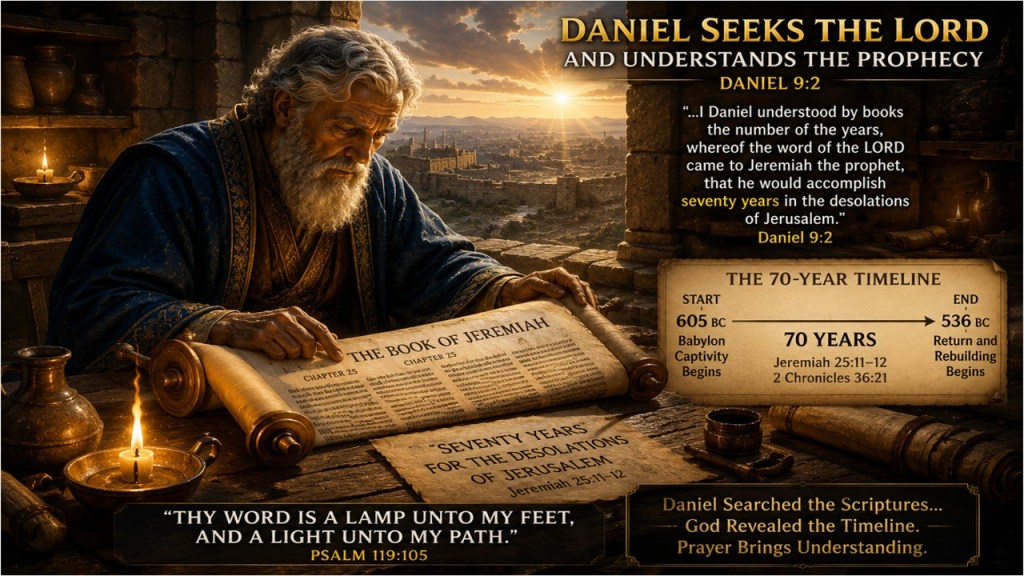
3 And I set my face unto the Lord God, to seek by prayer and supplications, with fasting, and sackcloth, and ashes:

4 And I prayed unto the Lord my God, and made my confession, and said, O Lord, the great and dreadful God, keeping the covenant and mercy to them that love him, and to them that keep his commandments;
5 We have sinned, and have committed iniquity, and have done wickedly, and have rebelled, even by departing from thy precepts and from thy judgments: 6 Neither have we hearkened unto thy servants the prophets, which spake in thy name to our kings, our princes, and our fathers, and to all the people of the land. 7 O Lord, righteousness belongeth unto thee, but unto us confusion of faces, as at this day; to the men of Judah, and to the inhabitants of Jerusalem, and unto all Israel, that are near, and that are far off, through all the countries whither thou hast driven them, because of their trespass that they have trespassed against thee. 8 O Lord, to us belongeth confusion of face, to our kings, to our princes, and to our fathers, because we have sinned against thee.
9 To the Lord our God belong mercies and forgivenesses, though we have rebelled against him; 10 Neither have we obeyed the voice of the Lord our God, to walk in his laws, which he set before us by his servants the prophets. 11 Yea, all Israel have transgressed thy law, even by departing, that they might not obey thy voice; therefore the curse is poured upon us, and the oath that is written in the law of Moses the servant of God, because we have sinned against him. 12 And he hath confirmed his words, which he spake against us, and against our judges that judged us, by bringing upon us a great evil: for under the whole heaven hath not been done as hath been done upon Jerusalem. 13 As it is written in the law of Moses, all this evil is come upon us: yet made we not our prayer before the Lord our God, that we might turn from our iniquities, and understand thy truth. 14 Therefore hath the Lord watched upon the evil, and brought it upon us: for the Lord our God is righteous in all his works which he doeth: for we obeyed not his voice. 15 And now, O Lord our God, that hast brought thy people forth out of the land of Egypt with a mighty hand, and hast gotten thee renown, as at this day; we have sinned, we have done wickedly. 16 O Lord, according to all thy righteousness, I beseech thee, let thine anger and thy fury be turned away from thy city Jerusalem, thy holy mountain: because for our sins, and for the iniquities of our fathers, Jerusalem and thy people are become a reproach to all that are about us. 17 Now therefore, O our God, hear the prayer of thy servant, and his supplications, and cause thy face to shine upon thy sanctuary that is desolate, for the Lord’s sake. 18 O my God, incline thine ear, and hear; open thine eyes, and behold our desolations, and the city which is called by thy name: for we do not present our supplications before thee for our righteousnesses, but for thy great mercies. 19 O Lord, hear; O Lord, forgive; O Lord, hearken and do; defer not, for thine own sake, O my God: for thy city and thy people are called by thy name.
Gabriel informs him of the seventy weeks
20 And whiles I was speaking, and praying, and confessing my sin and the sin of my people Israel, and presenting my supplication before the Lord my God for the holy mountain of my God; 21 Yea, whiles I was speaking in prayer, even the man Gabriel, whom I had seen in the vision at the beginning, being caused to fly swiftly, touched me about the time of the evening oblation. 22 And he informed me, and talked with me, and said, O Daniel, I am now come forth to give thee skill and understanding. 23 At the beginning of thy supplications the commandment came forth, and I am come to shew thee; for thou art greatly beloved: therefore understand the matter, and consider the vision. 24 Seventy weeks are determined upon thy people and upon thy holy city, to finish the transgression, and to make an end of sins, and to make reconciliation for iniquity, and to bring in everlasting righteousness, and to seal up the vision and prophecy, and to anoint the most Holy. 25 Know therefore and understand, that from the going forth of the commandment to restore and to build Jerusalem unto the Messiah the Prince shall be seven weeks, and threescore and two weeks: the street shall be built again, and the wall, even in troublous times. 26 And after threescore and two weeks shall Messiah be cut off, but not for himself: and the people of the prince that shall come shall destroy the city and the sanctuary; and the end thereof shall be with a flood, and unto the end of the war desolations are determined. 27 And he shall confirm the covenant with many for one week: and in the midst of the week he shall cause the sacrifice and the oblation to cease, and for the overspreading of abominations he shall make it desolate, even until the consummation, and that determined shall be poured upon the desolate. (Dan 9:1-27)
Daniel 9:1–19 KJV
Focus:
- Daniel studies Jeremiah.
- The Word of God leads him to prayer.
- National confession.
- Personal humility.
- Revival begins with repentance.
- Principles of effective prayer.
Outline
I. GOD’S WORD SHOULD DRIVE US TO PRAYER (9:1–3)
- A. Daniel Studied the Scriptures
- B. Daniel Believed God’s Promises
- C. Daniel Responded with Prayer
II. TRUE REVIVAL BEGINS WITH HUMBLE CONFESSION (9:4–15)
- A. Daniel Acknowledged God’s Holiness
- B. Daniel Identified with His People’s Sin
- C. Daniel Accepted God’s Righteous Judgment
III. GOD RESPONDS TO HUMBLE INTERCESSION (9:16–19)
- A. Daniel Prayed for God’s Glory
- B. Daniel Appealed to God’s Mercy
- C. Daniel Trusted God’s Covenant Faithfulness
- Lesson 9 becomes one of the finest Bible studies on prayer and revival in Scripture.
This is one of the greatest chapters on prayer in the entire Bible. Before God reveals the prophecy of the Seventy Weeks, He first shows us the heart of the man who received it. That is no accident. God often prepares the messenger before He reveals the message.
Introduction
Every great revival in Scripture begins the same way.
Not with crowds.
Not with music.
Not with programs.
But with someone who gets alone with God.
Daniel is now an elderly man.
He has served under multiple kings.
He has interpreted dreams.
Survived the lions’ den.
Watched kingdoms rise and fall.
Yet one of the greatest moments of his life does not happen in a palace.
It happens on his knees.
Daniel chapter nine reminds us that before God changes a nation,
He first changes a praying person.
If we want revival in our churches,
our homes,
our nation,
it will begin the same place it began for Daniel—
on our knees before Almighty God.
Historical Background
Daniel is now serving during the reign of Darius the Mede, shortly after Babylon has fallen. While studying the writings of the prophet Jeremiah, Daniel discovers that the seventy years of Judah’s captivity are almost complete. Instead of merely celebrating the promise of deliverance, Daniel is moved to humble himself before God in prayer, confession, fasting, and repentance. This chapter demonstrates the powerful connection between studying God’s Word and seeking God’s face in prayer.
God often reveals His greatest truths to those who first humble themselves in prayer.
Today we will discover three life-changing principles that teach us how God hears, honors, and answers humble, Bible-centered prayer.
I. GOD’S WORD SHOULD ALWAYS DRIVE US TO PRAYER
Daniel 9:1–3 KJV

One of the first things we notice is not Daniel praying.
It is Daniel reading.
The Bible says,
“I Daniel understood by books…”
(Daniel 9:2 KJV)
Daniel was studying the writings of Jeremiah.
He discovered God’s promise that Israel’s captivity would last seventy years.
Most people would have said,
“Wonderful! God’s already promised it, so there’s nothing left to do.”
Daniel responded differently.
God’s promise did not make him passive.
It drove him to prayer.
That teaches us an important truth.
God’s promises are not an excuse to stop praying.
They are an invitation to begin praying.
A. A Growing Christian Loves God’s Word
Even in his eighties,
Daniel still had a teachable heart.
He never reached the point where he thought,
“I already know enough.”
He remained a student of Scripture.
The older he became,
the more he treasured God’s Word.
That should challenge every believer.
Spiritual maturity never outgrows the Bible.
The mature Christian becomes more dependent upon it.
The greatest saints are lifelong students of God’s Word.
A. A Growing Christian Loves God’s Word
B. God’s Promises Strengthen Our Prayers
Daniel prayed because he believed what God had already said.
His prayer rested upon Scripture,
not emotion.
He was not trying to persuade God to keep His promise.
He was praying in agreement with God’s revealed will.
That is one of the greatest secrets of effective prayer.
The strongest prayers are prayers rooted in Scripture.
When we pray according to God’s Word,
our confidence grows.
We know we are praying within His will.
A. A Growing Christian Loves God’s Word
B. God’s Promises Strengthen Our Prayers
C. The Word of God Produces a Heart That Seeks God
Notice Daniel’s response.
He did not merely close the scroll.
He turned his face toward the Lord.
Bible study that never produces prayer
has missed its purpose.
The more we know about God,
the more we should desire God.
Knowledge without devotion creates pride.
Knowledge that leads to worship creates revival.
The Bible was never meant merely to fill our minds.
It was given to transform our hearts.
A Spiritual Insight
The greatest evidence that we believe God’s Word is not simply that we read it—
it is that we respond to it.
Daniel believed God’s promises enough to pray.
Faith always acts upon what God has said.
Pastor’s Commentary
Church family,
one of the greatest dangers we face is becoming familiar with Scripture without allowing Scripture to change us.
We can attend church.
Read our Bibles.
Listen to sermons.
Yet never allow God’s Word to move us to prayer.
Daniel would not let that happen.
Every truth he discovered about God drew him closer to God.
That is the kind of believer I want to be.
And that is the kind of church I believe God desires Bethel Crossroads Baptist Church to become—
a church that not only knows the Bible,
but kneels before the Author of the Bible.
Faith Builder
Ask yourself:
- Does my Bible reading lead me into prayer?
- Am I studying God’s Word merely for knowledge or for transformation?
- What promise from Scripture am I praying back to God today?
- Is my relationship with God growing deeper through His Word?
Christ Connection
Daniel found hope by reading Jeremiah’s promise of Israel’s restoration.
Today we have an even greater promise.
Jesus Christ is the living Word.
Every promise of God finds its fulfillment in Him.
As Daniel looked to God’s written promises,
we look to God’s living Son.
The same Savior who inspired Jeremiah,
heard Daniel,
and fulfilled every prophecy,
still hears every humble prayer offered in His name today.
After reading God’s Word, Daniel does something that every believer should do—he humbles himself before the Lord. His prayer is not filled with excuses or self-righteousness. Instead, it is marked by brokenness, confession, and genuine repentance. In our next section, we will discover that true revival always begins with honest confession before a holy God.
Today we will discover three life-changing principles that teach us how God hears, honors, and answers humble, Bible-centered prayer.
I. GOD’S WORD SHOULD ALWAYS DRIVE US TO PRAYER
Daniel 9:1–3 KJV
II. TRUE REVIVAL BEGINS WITH HUMBLE CONFESSION
Daniel 9:4–15 KJV
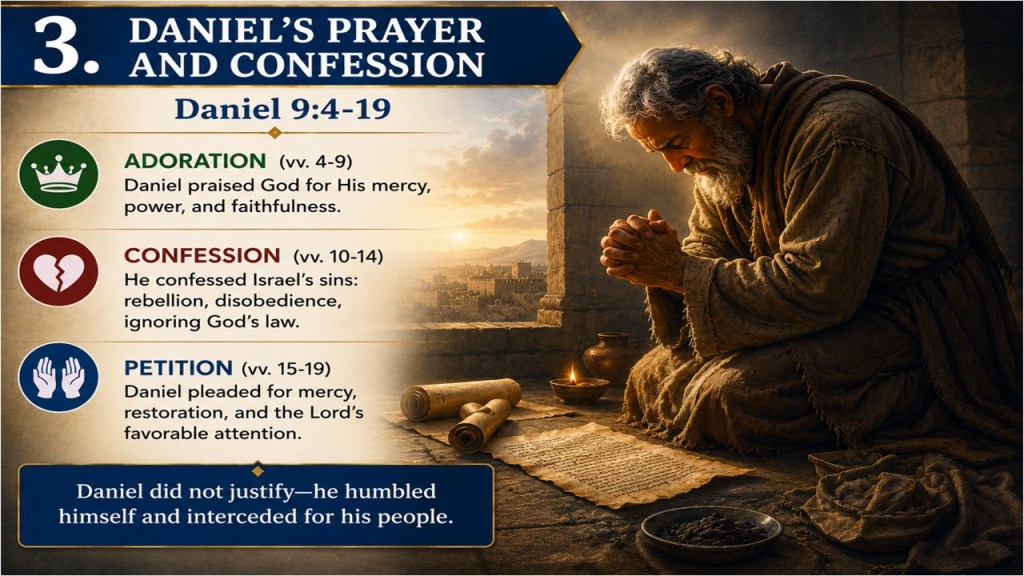
Daniel begins praying.
One of the first things we notice is what he does not do.
He does not blame Babylon.
He does not blame the politicians.
He does not blame his parents.
He does not blame the culture.
Instead, Daniel looks inward.
Although he had lived one of the most godly lives recorded in Scripture, he identifies himself with the sins of God’s people.
Repeatedly he says,
“We have sinned.”
That is the language of humility.
Real revival never begins by pointing fingers at someone else.
It begins when God’s people allow the Holy Spirit to point His finger at us.
A. Revival Begins When We See God for Who He Is
Daniel opens his prayer by praising God.
“O Lord, the great and dreadful God, keeping the covenant and mercy to them that love him…”
(Daniel 9:4 KJV)
Before Daniel talks about sin,
he talks about God.
Why?
Because the more clearly we see God’s holiness,
the more clearly we see our own sinfulness.
Isaiah experienced this.
When he saw the Lord high and lifted up,
he cried,
“Woe is me!”
(Isaiah 6:5 KJV)
Peter experienced the same truth.
After witnessing Christ’s miracle,
he fell before Jesus saying,
“Depart from me; for I am a sinful man, O Lord.”
(Luke 5:8 KJV)
The closer we draw to God,
the less interested we become in comparing ourselves with other people.
Instead,
we compare ourselves with His holiness.
That comparison always produces humility.
A. Revival Begins When We See God for Who He Is
B. Revival Requires Honest Confession
Daniel does not soften Israel’s guilt.
He says,
“We have sinned, and have committed iniquity, and have done wickedly, and have rebelled…”
(Daniel 9:5 KJV)
Notice the progression.
They sinned.
They acted wickedly.
They rebelled.
They departed from God’s commandments.
Daniel does not excuse sin.
He exposes it.
That is what confession really means.
It means agreeing with God about our sin.
Not explaining it away.
Not minimizing it.
Not blaming someone else.
God never heals what we refuse to acknowledge.
The road to restoration always passes through confession.
As John later wrote,
“If we confess our sins, he is faithful and just to forgive us our sins…”
(1 John 1:9 KJV)
A. Revival Begins When We See God for Who He Is
B. Revival Requires Honest Confession
C. Revival Accepts God’s Discipline
Daniel recognized something many people refuse to admit.
Israel’s captivity was not an accident.
It was the consequence of persistent disobedience.
God had warned them repeatedly through His prophets.
Yet they would not listen.
Daniel declared,
“O Lord, righteousness belongeth unto thee, but unto us confusion of faces…”
(Daniel 9:7 KJV)
Notice what Daniel says.
God is righteous.
We are guilty.
He does not accuse God of being unfair.
He admits that God’s judgment is just.
That is genuine repentance.
Repentance never argues with God.
It bows before Him.
Sometimes God lovingly disciplines His children.
Not to destroy them,
but to restore them.
Hebrews reminds us,
“For whom the Lord loveth he chasteneth…”
(Hebrews 12:6 KJV)
His discipline is proof of His love,
not the absence of it.
A. Revival Begins When We See God for Who He Is
B. Revival Requires Honest Confession
C. Revival Accepts God’s Discipline
D. Revival Listens to God’s Voice Again
One phrase echoes throughout Daniel’s prayer.
“Neither have we hearkened…”
Israel’s greatest problem was not ignorance.
It was disobedience.
They heard God’s Word.
They simply refused to obey it.
How relevant that is today.
America has more Bibles,
more churches,
more preaching,
and more Christian resources than perhaps any nation in history.
Yet hearing truth is not enough.
God blesses those who obey His truth.
James reminds us,
“Be ye doers of the word, and not hearers only…”
(James 1:22 KJV)
Revival begins when God’s people stop merely attending church
and start obeying what God has already said.
A Spiritual Insight
Brokenness is not weakness.
Brokenness is the doorway through which God’s restoring grace enters our lives.
God never despises a heart that humbly confesses its need for Him.
Pastor’s Commentary
Church family,
if there is one thing our generation desperately needs,
it is genuine repentance.
We live in a culture that excuses everything.
People excuse anger.
Excuse immorality.
Excuse dishonesty.
Excuse bitterness.
Excuse prayerlessness.
But Heaven never excuses sin.
Neither should we.
Revival will never begin in Washington.
It will not begin in Hollywood.
It will not begin in the courthouse.
It begins in the house of God.
And it begins when God’s people are willing to say,
“Lord…start with me.”
Before we ask God to change America,
let us ask Him to change our hearts.
Before we pray for national revival,
let us seek personal revival.
Daniel did not pray,
“They have sinned.”
He prayed,
“We have sinned.”
That is the heart God blesses.
Faith Builder
Ask yourself:
- Is there any unconfessed sin hindering my fellowship with God?
- Do I quickly admit my failures, or do I excuse them?
- Am I listening to God’s Word with the intention of obeying it?
- What area of my life needs genuine repentance today?
Christ Connection
Daniel confessed the sins of the people,
even though he personally lived a faithful life.
In doing so,
he points us to Someone infinitely greater.
Jesus Christ identified Himself with sinners,
though He Himself was without sin.
Daniel confessed sins that were partly his nation’s.
Jesus bore sins that were entirely ours.
Daniel prayed for forgiveness.
Jesus purchased forgiveness with His own blood.
Daniel pleaded for mercy.
Jesus became mercy in human flesh.
At the cross,
God’s justice and God’s mercy met together.
Because Christ bore our judgment,
every repentant sinner can receive complete forgiveness and a brand-new beginning.
Daniel’s prayer now reaches its highest point. Having confessed Israel’s sin and acknowledged God’s righteous judgment, he boldly appeals to God’s mercy and glory. His greatest concern is not personal comfort but the honor of God’s holy name. In our final section, we will discover that the prayers God delights to answer are the prayers that seek His glory above all else.
Today we will discover three life-changing principles that teach us how God hears, honors, and answers humble, Bible-centered prayer.
I. GOD’S WORD SHOULD ALWAYS DRIVE US TO PRAYER
Daniel 9:1–3 KJV
II. TRUE REVIVAL BEGINS WITH HUMBLE CONFESSION
Daniel 9:4–15 KJV
III. GOD HONORS PRAYERS THAT SEEK HIS GLORY
Daniel 9:16–19 KJV
As Daniel comes to the close of his prayer,
his requests become more passionate.
He cries,
“O Lord, hear… O Lord, forgive… O Lord, hearken and do…”
(Daniel 9:19 KJV)
Daniel is no longer simply confessing sin.
He is pleading for God’s intervention.
Yet notice something remarkable.
He never claims Israel deserves God’s blessing.
Instead,
he appeals entirely to God’s mercy.
That is how every believer must approach the throne of grace.
We come,
not because we deserve His favor,
but because Jesus Christ has made a way.
A. God’s Mercy Is Greater Than Our Failure
Daniel knew Israel had failed.
They had broken God’s covenant.
Rejected His prophets.
Ignored His warnings.
Yet Daniel also knew something else.
God’s mercy is greater than man’s failure.
He prayed,
“O Lord… according to all thy righteousness…”
(Daniel 9:16 KJV)
Notice that Daniel does not ask God to ignore sin.
He asks God to act according to His righteous character.
The same God who judges sin
also delights in showing mercy to those who repent.
Micah declared,
“Who is a God like unto thee, that pardoneth iniquity…?”
(Micah 7:18 KJV)
Every believer has experienced that mercy.
If God treated us only according to our failures,
none of us could stand.
But praise God,
His mercy triumphs over our past.
A. God’s Mercy Is Greater Than Our Failure
B. God’s Reputation Matters More Than Our Comfort
Daniel’s greatest concern was Jerusalem.
Not because it was merely his hometown.
But because it was God’s city.
He prayed,
“…thy city and thy people are called by thy name.”
(Daniel 9:19 KJV)
Daniel wanted the surrounding nations
to see the greatness of Israel’s God.
His prayer was centered upon God’s glory.
How different that is from many of our prayers.
Too often,
our prayers revolve around
our plans,
our comfort,
our success,
our desires.
Daniel teaches us to ask,
“Lord,
what will bring You the greatest glory?”
When God’s glory becomes our greatest desire,
our prayers begin to reflect Heaven’s priorities.
A. God’s Mercy Is Greater Than Our Failure
B. God’s Reputation Matters More Than Our Comfort
C. God Delights in Humble Dependence
Daniel closes with these words:
“…for we do not present our supplications before thee for our righteousnesses, but for thy great mercies.”
(Daniel 9:18 KJV)
That may be one of the greatest statements on prayer in all of Scripture.
Daniel understood
that prayer is never based upon human merit.
It is based upon divine mercy.
We cannot earn God’s answers.
We cannot deserve His blessings.
Every answer to prayer
is an act of God’s grace.
That truth removes pride
and produces gratitude.
Every time God answers prayer,
we are reminded
how good He truly is.
A. God’s Mercy Is Greater Than Our Failure
B. God’s Reputation Matters More Than Our Comfort
C. God Delights in Humble Dependence
D. God Hears the Cry of a Humble Heart
Daniel finishes with urgency.
“O Lord, hear… O Lord, forgive… O Lord, hearken and do…”
(Daniel 9:19 KJV)
His prayer is earnest.
His heart is broken.
His faith is unwavering.
And before Daniel even finishes praying,
God is already sending Gabriel with the answer.
What encouragement!
Sometimes God’s answers come quickly.
Sometimes they require waiting.
But every sincere prayer reaches the throne of God.
Not one tear is unnoticed.
Not one cry is ignored.
Not one prayer offered in faith is wasted.
Our Heavenly Father hears His children.
A Spiritual Insight
God is not looking for impressive words.
He is looking for surrendered hearts.
The prayer that moves Heaven
is the prayer that seeks God’s glory above personal gain.
Pastor’s Commentary
I wonder what would happen
if every member of Bethel Crossroads Baptist Church
prayed like Daniel.
Not hurried prayers.
Not routine prayers.
But broken-hearted,
Bible-centered,
God-honoring prayers.
Imagine homes filled with prayer.
Imagine husbands and wives praying together.
Parents praying with their children.
Young people seeking God before making life decisions.
Senior adults finishing their race on their knees.
I truly believe
our greatest need is not another program.
It is another prayer meeting.
When God’s people humble themselves before Him,
He still hears.
He still forgives.
He still restores.
He still sends revival.
May it begin with us.
Faith Builder
Ask yourself:
- Are my prayers centered on God’s glory or my own comfort?
- Do I truly believe God hears every sincere prayer?
- Is there someone or something I need to begin praying for with greater faith?
- What would change if I devoted myself to prayer like Daniel?
Christ Connection
Daniel approached God
because of His great mercy.
Today,
we approach the Father
through an even greater provision.
Jesus Christ,
our great High Priest.
Daniel stood before God pleading for mercy.
Jesus now stands at the Father’s right hand
interceding for His redeemed people.
Daniel prayed for the restoration of Jerusalem.
Jesus is preparing the New Jerusalem.
Daniel looked forward to the coming Messiah.
We look back to the finished work of the cross
and forward to the glorious return of our Savior.
Because Jesus lives,
we can come boldly unto the throne of grace,
knowing our prayers are welcomed,
our sins are forgiven,
and our future is secure in Him.
Lesson Nine Summary
Daniel 9:1–19 teaches us that genuine revival begins when God’s people return to His Word and humble themselves in prayer. As Daniel studied the prophecy of Jeremiah, God’s promises moved him to repentance rather than complacency. His prayer was marked by humility, confession, and a deep concern for God’s glory instead of personal comfort. Rather than blaming others, Daniel identified with the sins of his nation and appealed solely to the mercy of God. His example reminds us that the Lord delights in hearing the prayers of humble, repentant hearts and that lasting spiritual renewal always begins on our knees before Him.
Memory Verse
Daniel 9:18 (KJV)
“…for we do not present our supplications before thee for our righteousnesses, but for thy great mercies.”
Reflection Questions
- Does my study of God’s Word naturally lead me into prayer?
- Is there any sin I need to confess honestly before the Lord?
- Are my prayers more focused on God’s glory than my own comfort?
- What can I learn from Daniel’s humility and dependence upon God?
- How can I make prayer a greater priority in my daily walk with Christ?
The heart that is humbled before God is the heart that Heaven delights to hear.
Looking Ahead — Lesson Ten
WHEN GOD REVEALS HIS REDEMPTIVE CALENDAR

Daniel 9:20–27
Next week we will study one of the greatest prophetic passages in all of Scripture. While Daniel is still praying, the angel Gabriel arrives with God’s answer and reveals the remarkable prophecy of the Seventy Weeks. We will see God’s perfect timetable for Israel, the coming of the Messiah, Christ’s sacrificial death, the future Tribulation, and the certainty that God’s prophetic plan will be fulfilled exactly as He has declared. It is a lesson that strengthens our confidence that the God who controls history also holds our future securely in His hands.
