

Series:
Living for God in a World that Has Forgotten Him
Daniel 8:1-27 KJV

The Book of Daniel
Lesson Eight
WHEN GOD REVEALS THE NEXT EMPIRE
Trusting God’s Plan When the Future Seems Uncertain
Daniel 8 (KJV)
Lesson Eight Summary
Daniel chapter eight demonstrates the absolute accuracy of God’s Word by revealing the rise of the Medo-Persian and Greek Empires centuries before they came to power. Through the visions of the ram, the goat, and the little horn, God showed Daniel that earthly kingdoms are temporary, human power quickly fades, and evil rulers ultimately answer to Him. Antiochus Epiphanes fulfilled much of this prophecy and foreshadowed the coming Antichrist, reminding us that while evil may flourish for a season, it can never overthrow God’s sovereign plan. Believers can live with confidence because history is moving exactly according to God’s Word, and Jesus Christ will have the final victory.
Daniel‘s Third Vision:
CHAPTER 8
The Vision of the Ram and the He Goat
| Approx. Date | Chapter | Ruler / Setting | Vision or Revelation |
| c. 603–602 B.C. | Daniel 2 | 2nd year of Nebuchadnezzar | Great Image — Four Gentile Kingdoms |
| c. 553 B.C. | Daniel 7 | 1st year of Belshazzar | Four Beasts, Little Horn & Son of Man |
| c. 551 B.C. | Daniel 8 | 3rd year of Belshazzar | Ram, He-Goat & Little Horn |
| 539 B.C. | Daniel 9 | 1st year of Darius the Mede | Seventy Weeks |
| 536 B.C. | Daniel 10–12 | 3rd year of Cyrus | Final Vision — Israel, Antichrist, Tribulation & Resurrection |
Daniel 7 specifically dates its vision to the first year of Belshazzar, while Daniel 10 places in the third year of Cyrus.
THE RAM AND THE HE-GOAT
Daniel 8 — Approximately 551 B.C.
Third year of Belshazzar
Only about two years after Daniel 7, Daniel receives another vision.
This time God becomes remarkably specific.
Daniel sees:
A Ram with two horns — Medo-Persia
A He-Goat from the west — Greece
The great horn — Alexander the Great
The horn broken
Four horns replacing it — division of Alexander’s empire
Then appears another little horn.
The chapter itself identifies the ram with the kings of Media and Persia and the goat with Greece; this vision develops the kingdom imagery of Daniel 7 in considerably greater detail.
The immediate historical fulfillment centers especially upon Antiochus IV Epiphanes, the Seleucid ruler who brutally persecuted the Jewish people and desecrated the Temple.
But from a futurist prophetic perspective, Antiochus becomes an important foreshadowing or type of the coming Antichrist.
That distinction is important:
Daniel 8’s little horn and Daniel 7’s little horn should not simply be treated as identical in their immediate historical setting.
Daniel 8 gives us Antiochus historically while providing patterns that anticipate the greater final persecutor.
Prophetic truth: God can describe history before mankind lives it.
One of the most important things to explain when teaching Daniel because the book is not arranged in strict chronological order.
Daniel 5 is usually placed at 539 BC, when Babylon fell to the Medes and Persians. Daniel 8 occurred earlier, around 551/550 BC, during Belshazzar’s third year.
A simple way to explain it:
Think of Daniel as being arranged by subject as well as by time.
| Chapter | Approx. Date | Event |
|---|---|---|
| Daniel 1 | 605 BC | Daniel taken to Babylon |
| Daniel 2 | 603/602 BC | Nebuchadnezzar’s image |
| Daniel 3 | During Nebuchadnezzar’s reign | Fiery furnace |
| Daniel 4 | During Nebuchadnezzar’s reign | Nebuchadnezzar humbled |
| Daniel 7 | 553 BC | Belshazzar’s 1st year |
| Daniel 8 | 551/550 BC | Belshazzar’s 3rd year |
| Daniel 5 | 539 BC | Babylon falls |
| Daniel 6 | After 539 BC | Daniel and the lions |
| Daniel 9 | 539/538 BC | First year of Darius |
Daniel 4 → Daniel 7 → Daniel 8 → Daniel 5 → Daniel 6 → Daniel 9.
Then why didn’t Daniel arrange them that way?
Because Daniel has a remarkable literary structure.
Daniel 1 introduces the whole book.
Then Daniel 2–7 forms a major section dealing especially with Gentile kingdoms and God’s sovereignty over them. Significantly, Daniel 2:4b through 7:28 is written primarily in Aramaic, the international language of that world, rather than Hebrew.
That section has a beautiful pattern:
Daniel 2 — Four world kingdoms
Daniel 3 — God’s servants delivered
Daniel 4 — A Gentile king humbled
Daniel 5 — A Gentile king judged
Daniel 6 — God’s servant delivered
Daniel 7 — Four world kingdoms
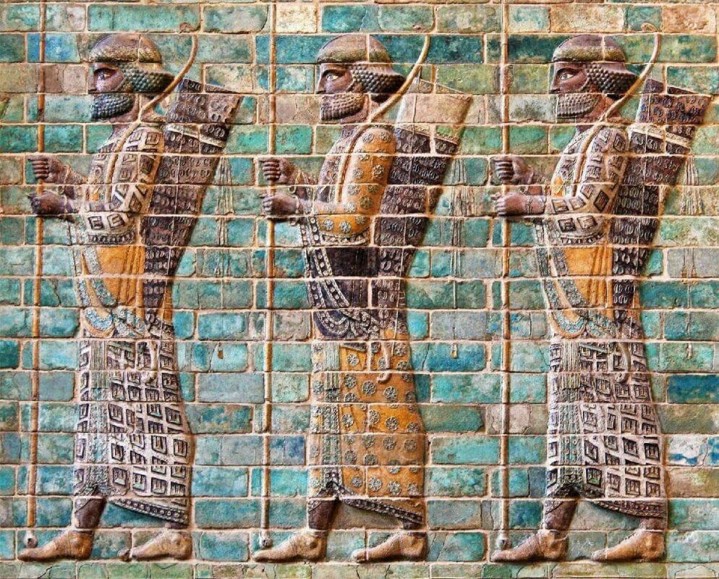
Notice it?
2 corresponds with 7.
3 corresponds with 6.
4 corresponds with 5.
That is why Daniel 5 follows Daniel 4 even though Daniel 7 and 8 happened chronologically before Daniel 5.
Daniel is keeping the message uninterrupted.
Chapter 8
Daniel’s vision of the ram and the he-goat
1 In the third year of the reign of king Belshazzar a vision appeared unto me, even unto me Daniel, after that which appeared unto me at the first. 2 And I saw in a vision; and it came to pass, when I saw, that I was at Shushan in the palace, which is in the province of Elam; and I saw in a vision, and I was by the river of Ulai. 3 Then I lifted up mine eyes, and saw, and, behold, there stood before the river a ram which had two horns: and the two horns were high; but one was higher than the other, and the higher came up last. 4 I saw the ram pushing westward, and northward, and southward; so that no beasts might stand before him, neither was there any that could deliver out of his hand; but he did according to his will, and became great. 5 And as I was considering, behold, an he goat came from the west on the face of the whole earth, and touched not the ground: and the goat had a notable horn between his eyes. 6 And he came to the ram that had two horns, which I had seen standing before the river, and ran unto him in the fury of his power. 7 And I saw him come close unto the ram, and he was moved with choler against him, and smote the ram, and brake his two horns: and there was no power in the ram to stand before him, but he cast him down to the ground, and stamped upon him: and there was none that could deliver the ram out of his hand. 8 Therefore the he goat waxed very great: and when he was strong, the great horn was broken; and for it came up four notable ones toward the four winds of heaven. 9 And out of one of them came forth a little horn, which waxed exceeding great, toward the south, and toward the east, and toward the pleasant land. 10 And it waxed great, even to the host of heaven; and it cast down some of the host and of the stars to the ground, and stamped upon them. 11 Yea, he magnified himself even to the prince of the host, and by him the daily sacrifice was taken away, and the place of his sanctuary was cast down. 12 And an host was given him against the daily sacrifice by reason of transgression, and it cast down the truth to the ground; and it practised, and prospered. 13 Then I heard one saint speaking, and another saint said unto that certain saint which spake, How long shall be the vision concerning the daily sacrifice, and the transgression of desolation, to give both the sanctuary and the host to be trodden under foot? 14 And he said unto me, Unto two thousand and three hundred days; then shall the sanctuary be cleansed.
Gabriel comforts Daniel and interprets the vision
15 And it came to pass, when I, even I Daniel, had seen the vision, and sought for the meaning, then, behold, there stood before me as the appearance of a man. 16 And I heard a man’s voice between the banks of Ulai, which called, and said, Gabriel, make this man to understand the vision. 17 So he came near where I stood: and when he came, I was afraid, and fell upon my face: but he said unto me, Understand, O son of man: for at the time of the end shall be the vision. 18 Now as he was speaking with me, I was in a deep sleep on my face toward the ground: but he touched me, and set me upright. 19 And he said, Behold, I will make thee know what shall be in the last end of the indignation: for at the time appointed the end shall be. 20 The ram which thou sawest having two horns are the kings of Media and Persia. 21 And the rough goat is the king of Grecia: and the great horn that is between his eyes is the first king. 22 Now that being broken, whereas four stood up for it, four kingdoms shall stand up out of the nation, but not in his power. 23 And in the latter time of their kingdom, when the transgressors are come to the full, a king of fierce countenance, and understanding dark sentences, shall stand up. 24 And his power shall be mighty, but not by his own power: and he shall destroy wonderfully, and shall prosper, and practise, and shall destroy the mighty and the holy people. 25 And through his policy also he shall cause craft to prosper in his hand; and he shall magnify himself in his heart, and by peace shall destroy many: he shall also stand up against the Prince of princes; but he shall be broken without hand. 26 And the vision of the evening and the morning which was told is true: wherefore shut thou up the vision; for it shall be for many days. 27 And I Daniel fainted, and was sick certain days; afterward I rose up, and did the king’s business; and I was astonished at the vision, but none understood it. (Dan 8:1-27)
Daniel 8 is one of the strongest evidences that the Bible is the inspired Word of God because God foretold kingdoms and rulers centuries before they appeared. .
Introduction
One of the greatest attacks against Christianity today is aimed at the Bible itself.
People say,
“The Bible is just another religious book.”
“It is full of myths.”
“It cannot be trusted.”
Yet Daniel chapter eight destroys those arguments.
Over two hundred years before Alexander the Great was born…
God described his kingdom.
Before the Persian Empire reached its height…
God revealed its future.
Before Antiochus Epiphanes persecuted Israel…
God told Daniel what would happen.
Only the God who controls history can write history before it happens.
That is exactly what Daniel chapter eight proves.
This chapter reminds us that our faith does not rest upon blind hope.
It rests upon the unchanging Word of Almighty God.
Daniel specifically says:
ARCHAEOLOGY & ARCHITECTURE OF DANIEL 8
SHUSHAN — THE PALACE, THE MEASUREMENTS, AND THE MESSAGE
Daniel 8:2 KJV
“And I saw in a vision; and it came to pass, when I saw, that I was at Shushan in the palace, which is in the province of Elam; and I saw in a vision, and I was by the river of Ulai.”
When Daniel mentions Shushan, or Susa, he identifies a real ancient city that would become one of the great royal centers of the Persian Empire.

This makes Daniel 8 especially fascinating.
Daniel is still living during the Babylonian period when he receives the vision, but God allows him to see himself at a location that would become closely associated with the next great empire—Medo-Persia.
The location itself fits the message of the prophecy.
Daniel is shown Persia’s future while standing, in vision, in a place associated with Persia’s future greatness.
THE GREAT PERSIAN PALACE COMPLEX AT SUSA
The great Achaemenid palace complex that archaeology has uncovered at Susa is particularly associated with Darius I, who reigned after the Babylonian period of Daniel 8.
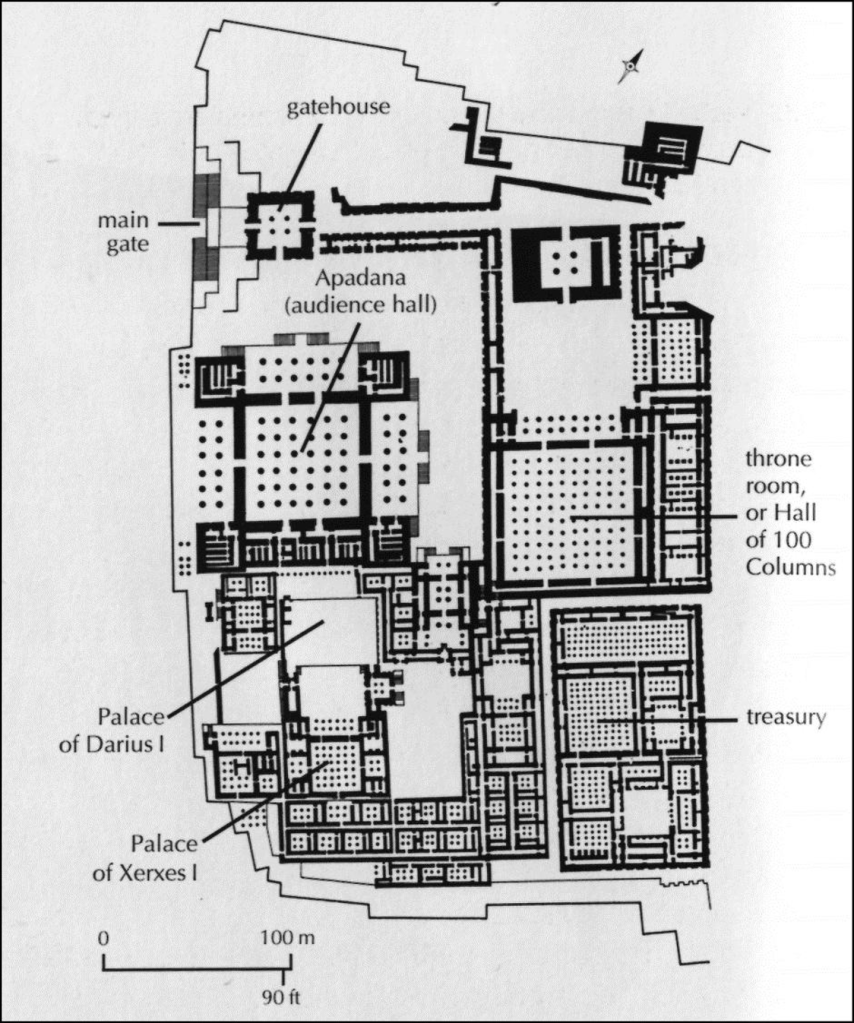
Its enormous audience hall, known as the Apadana, demonstrates the remarkable planning and engineering of Persian architecture.
The Apadana measured approximately:
109 METERS × 109 METERS
That is approximately:
358 FEET × 358 FEET.
Inside was an enormous central audience hall measuring approximately:
58 METERS × 58 METERS
or roughly:
190 FEET × 190 FEET.
The central hall contained:
36 MASSIVE COLUMNS
They were arranged:
6 × 6.
The columns originally rose to approximately:
20 METERS HIGH
or about:
65 FEET.

The palace therefore communicated something before the king ever spoke:
ORDER.
POWER.
MAJESTY.
AUTHORITY.
EMPIRE.
THE MATHEMATICS OF THE PALACE
Look at the order.
6 columns × 6 columns = 36 columns.
The great hall was essentially square.
The larger Apadana complex was also organized around a square plan.
Columns were positioned in orderly rows.
Entrances, porticoes, foundations, walls, and audience areas were carefully planned.
The Persians understood:
Measurement.
Geometry.
Symmetry.
Proportion.
Balance.
Order.
Some modern discussions look for the mathematical Golden Ratio—approximately 1.618—in ancient Persian architecture.
We should be careful here.
There is not enough evidence to say confidently that the Achaemenid Persian architects deliberately designed these palaces according to the exact mathematical formula we now call the Golden Ratio.
But we do not need that claim to appreciate their achievement.
The archaeological evidence itself demonstrates extraordinary use of measurement, geometric planning, repetition, proportion, symmetry, and structural balance.
PUT THE SIZE INTO PERSPECTIVE
Imagine Daniel looking across a Persian royal complex.
A central hall roughly 190 feet square.
Thirty-six enormous columns.
Columns rising approximately 65 feet into the air.
Massive walls.
Royal courtyards.
Guards.
Officials.
Servants.
Foreign representatives.
Gold.
Silver.
Decorative brickwork.
Everything was designed to communicate:
“THIS KINGDOM IS GREAT.”
But Daniel 8 reveals something the architects couldn’t calculate.
GOD HAD ALREADY MEASURED THE FUTURE OF THE EMPIRE.
The Persians could measure their buildings.
GOD MEASURED THEIR KINGDOM.
They could calculate the spacing between columns.
GOD CALCULATED THE YEARS OF THEIR DOMINION.
They could establish the boundaries of a palace.
GOD ESTABLISHED THE BOUNDARIES OF THEIR EMPIRE.
They could determine where a column would stand.
GOD DETERMINED HOW LONG A KINGDOM WOULD STAND.
THE PALACE AND THE RAM
Now Daniel sees:
Daniel 8:3 KJV
“…behold, there stood before the river a ram which had two horns: and the two horns were high; but one was higher than the other, and the higher came up last.”
Gabriel eventually removes all doubt concerning its identity.
Daniel 8:20 KJV
“The ram which thou sawest having two horns are the kings of Media and Persia.”
Think about the picture.
Daniel sees himself at Shushan—
and then God shows him the kingdom of Media and Persia.
That kingdom would become enormous.
Its rulers would build magnificent palaces.
Its architects would erect towering columns.
Its administrators would govern vast territories.
Its armies would conquer nations.
Yet before Persia reached the height of its greatness—
GOD HAD ALREADY WRITTEN ITS HISTORY!
THEN GOD SHOWED DANIEL THE NEXT EMPIRE
Daniel sees the he-goat coming from the west.
Daniel 8:5 KJV
“…behold, an he goat came from the west on the face of the whole earth, and touched not the ground…”
The ram appears powerful.
Then suddenly the goat arrives.
The Persian Empire that appeared so permanent would eventually fall to Greece.
Gabriel explains:
Daniel 8:21 KJV
“And the rough goat is the king of Grecia: and the great horn that is between his eyes is the first king.”
The architecture said:
“PERSIA WILL LAST.”
The palace said:
“LOOK AT OUR POWER.”
The columns said:
“LOOK AT OUR STRENGTH.”
But prophecy said:
“ANOTHER KINGDOM IS COMING.”
That is the message Daniel’s congregation—and ours—must never forget.
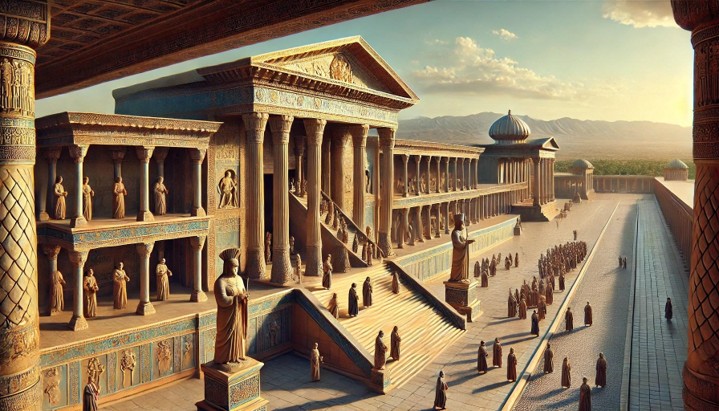
THE BUILDINGS WERE MEASURED — BUT SO WAS THE EMPIRE
This provides a beautiful connection between Daniel chapters 5 and 8.
In Daniel 5, God told Belshazzar:
MENE — NUMBERED.
TEKEL — WEIGHED.
PERES — DIVIDED.
Then Persia took Babylon.
But in Daniel 8, God reveals that the conquering Persian Empire itself would eventually be conquered.
What a lesson!
BABYLON WASN’T PERMANENT.
PERSIA WASN’T PERMANENT.
GREECE WASN’T PERMANENT.
ROME WASN’T PERMANENT.
And no earthly kingdom today is permanent.
Only God’s Kingdom is eternal.
ARCHITECTURE BECOMES AN OBJECT LESSON
Standing in one of those magnificent royal complexes, a person could easily believe:
“Surely this will last forever.”
But today much of what remains of these ancient palaces is archaeology.
Columns fell.
Walls crumbled.
Kings died.
Dynasties disappeared.
Empires changed.
But something survived every one of them:
THE WORD OF GOD.
The palace became ruins.
THE PROPHECY BECAME HISTORY.
The king disappeared.
GOD’S WORD REMAINED.
The empire fell.
GOD’S PLAN CONTINUED.
PASTOR’S COMMENTARY
Church family, there is something here that we cannot afford to miss.
Men are impressed by size.
God is concerned with sovereignty.
Men measure buildings.
God measures kingdoms.
Men count columns.
God counts generations.
Men draw architectural plans.
GOD DRAWS THE MAP OF HISTORY.
Before Persia reached the height of its glory, God knew Greece was coming.
Before Alexander was born, God knew his victories.
Before Alexander’s kingdom was divided, God knew the four divisions that would follow.
Before Antiochus Epiphanes appeared, God knew what he would do.
And before tomorrow arrives—
GOD IS ALREADY THERE.
That means Daniel 8 isn’t merely telling us about ancient architecture or ancient kingdoms.
It is telling us something about our God.
If God knew the future of Babylon, Persia, Greece, Alexander, and Antiochus—
HE KNOWS YOUR FUTURE TOO.
You may not know what tomorrow holds.
But you know Who holds tomorrow.
FAITH BUILDER
When the future seems uncertain, remember the palace at Shushan.
The men who built the great Persian palaces planned carefully for their future.
But only God already knew it.
Our security is not found in what we can build.
Our security is found in the God who knows what is coming.
That is why we can live:
LIVING FOR GOD IN A WORLD THAT HAS FORGOTTEN HIM.
Those measurements are well supported archaeologically. The Susa Apadana is described as about 109 m square, with a 58 m × 58 m central hall, a 6 × 6 arrangement of 36 columns, and an original height around 20 m. (Iranica Online)
Historical Background
Daniel receives this vision during the third year of Belshazzar’s reign, approximately 551 B.C. Although the events of chapters five and six have not yet occurred chronologically, God again pulls back the curtain and reveals the future. “Daniel saw himself in Shushan (Susa), an ancient city that would become one of the great royal centers of the Persian Empire and later figures prominently in the biblical story of Esther.”
In this chapter the language of Daniel changes from Aramaic back to Hebrew because the remaining prophecies focus especially upon God’s dealings with Israel.
God knows every kingdom before it rises, every ruler before he reigns, and every victory before it is won.
I. GOD’S WORD ALWAYS PROVES TRUE
Daniel 8:1–14 KJV
Daniel is given another vision.
This time he sees two unusual animals.
A ram.
A goat.
At first the vision seems mysterious.
But later God explains exactly what they represent.
The ram represents the Medo-Persian Empire.
The goat represents Greece.
The notable horn represents Alexander the Great.
Think about that.
Daniel lived more than two centuries before Alexander was born.
Yet God revealed the future in remarkable detail.
That is not human wisdom.
That is divine revelation.
A. God Reveals the Future Because He Controls It
Only God can declare the end from the beginning.
Men make predictions.
God makes prophecies.
Human predictions often fail.
God’s prophecies never fail.
Everything happened exactly as God declared.
Persia rose.
Greece conquered.
Alexander came swiftly across the known world.
History unfolded exactly according to God’s Word.
Our faith is built upon a Book that has never been proven wrong.
A. God Reveals the Future Because He Controls It
B. God’s Word Strengthens Our Faith
Daniel did not fully understand everything he saw.
But he trusted the One who revealed it.
Many times we also do not understand what God is doing.
We wonder why trials come.
Why prayers seem delayed.
Why the future appears uncertain.
But Daniel reminds us that we can trust God’s Word even when we cannot trace God’s hand.
Faith does not require complete understanding.
Faith requires confidence in God’s character.
A. God Reveals the Future Because He Controls It
B. God’s Word Strengthens Our Faith
C. God’s Purposes Are Never Delayed
From Daniel’s perspective,
these events were centuries away.
Yet to God,
they were already settled.
God’s timetable is never late.
Never rushed.
Never uncertain.
He moves according to His perfect plan.
That truth should give us great peace.
If God governs world empires,
He certainly knows how to guide our individual lives.
A Spiritual Insight
Bible prophecy is not given merely to satisfy our curiosity about tomorrow.
It is given to strengthen our confidence today.
Every fulfilled prophecy reminds us that the promises still awaiting fulfillment will also come to pass.
Pastor’s Commentary
As your pastor,
one of my greatest desires is that you learn to trust the Bible completely.
Not just when it comforts you.
Not just when it agrees with your plans.
But every day.
When the world says the Bible is outdated,
remember Daniel.
When skeptics laugh at God’s Word,
remember Daniel.
When you begin wondering if God is still working,
remember Daniel.
History has never embarrassed the Bible.
History continues to confirm it.
The God who fulfilled these prophecies will also fulfill every promise He has made to His children.
Faith Builder
Ask yourself:
- Do I truly believe God’s Word is completely trustworthy?
- Am I allowing current events to strengthen my faith in Scripture?
- What promise of God do I need to trust today?
- Am I building my life upon God’s truth or the world’s opinions?
Christ Connection
Every fulfilled prophecy points us to Jesus Christ.
If God was faithful to fulfill His promises concerning Persia…
Greece…
Alexander…
and Israel…
then we can be certain He will fulfill every promise concerning His Son.
Jesus came exactly as the prophets declared.
He died exactly as the prophets declared.
He rose again exactly as the prophets declared.
And one day,
He will return exactly as the prophets declare.
Because God’s Word has never failed,
our hope in Christ is absolutely certain.
Daniel now watches the mighty Greek Empire rise with incredible speed under one remarkable leader. Yet just when this great ruler seems unstoppable, everything suddenly changes. God reminds us that no matter how powerful a person becomes, pride always has an expiration date. In our next section we will discover that human greatness quickly fades, but God’s Kingdom stands forever.
I. GOD’S WORD ALWAYS PROVES TRUE
Daniel 8:1–14 KJV
II. HUMAN POWER IS TEMPORARY, BUT GOD’S PURPOSES ARE ETERNAL
Daniel 8:5–22 KJV
As Daniel continued watching the vision, something remarkable happened.
A goat came from the west.
It moved with incredible speed.
The Bible says it seemed to
“…touch not the ground…”
(Daniel 8:5 KJV)
The picture is one of lightning-fast conquest.
History tells us this was fulfilled in Alexander the Great.
In less than a decade, he conquered one of the largest empires the world had ever known.
City after city fell before him.
Nation after nation surrendered.
The world stood amazed.
Yet Daniel saw something even more amazing.
Just as Alexander reached the height of his power…
his strength was suddenly broken.
A. Earthly Success Can Never Replace God
Alexander conquered kingdoms,
but he never conquered himself.
He ruled nations,
but he could not rule his own pride.
History records that after conquering the known world,
he wept because there were no more worlds to conquer.
Yet all of his victories could not satisfy the emptiness of his heart.
That is still true today.
People pursue success.
Money.
Recognition.
Influence.
Possessions.
Titles.
Yet none of those things can satisfy the soul.
Only Jesus Christ can do that.
As Solomon declared,
“Vanity of vanities; all is vanity.”
(Ecclesiastes 1:2 KJV)
Without God,
the greatest earthly success still ends in emptiness.
A. Earthly Success Can Never Replace God
B. Pride Always Leads to Destruction
Alexander appeared invincible.
No army could stop him.
No nation could resist him.
Yet the greatest enemy Alexander ever faced
was not Persia.
It was pride.
The Bible reminds us,
“Pride goeth before destruction, and an haughty spirit before a fall.”
(Proverbs 16:18 KJV)
How often history repeats that truth.
Kings.
Presidents.
Business leaders.
Athletes.
Celebrities.
Even preachers.
Whenever pride replaces humility,
destruction soon follows.
God blesses humble hearts.
But He resists the proud.
Daniel’s vision reminds us that no human being is indispensable.
God’s work continues long after earthly leaders are gone.
A. Earthly Success Can Never Replace God
B. Pride Always Leads to Destruction
C. God Raises Up Leaders for His Own Purposes
When Alexander died,
his kingdom did not remain united.
The great horn was broken.
Four smaller horns arose in its place.
Exactly as Daniel had prophesied centuries earlier.
God was still directing history.
Leaders changed.
Empires shifted.
But God’s plan continued without interruption.
The Lord has always used human rulers to accomplish His divine purposes.
Sometimes they honor Him.
Sometimes they oppose Him.
But none of them can frustrate His eternal plan.
The Lord is never searching for a solution.
He already knows the outcome.
A. Earthly Success Can Never Replace God
B. Pride Always Leads to Destruction
C. God Raises Up Leaders for His Own Purposes
D. Every Earthly Kingdom Has an Ending
One lesson echoes throughout Daniel.
Babylon ended.
Persia ended.
Greece ended.
Rome declined.
Every earthly empire eventually falls.
Why?
Because everything built by sinful hands eventually passes away.
Only the Kingdom of God endures forever.
Jesus said,
“Lay not up for yourselves treasures upon earth…”
(Matthew 6:19 KJV)
Our greatest investment should never be in temporary things.
It should always be in eternal things.
A Spiritual Insight
God often allows people to reach the height of their own strength before showing them how dependent they truly are.
The stronger we believe we are without God,
the more painful our fall becomes.
But the believer who humbly depends upon the Lord discovers strength that never fades.
Pastor’s Commentary
our culture celebrates success.
People admire wealth.
Power.
Popularity.
Influence.
But Heaven measures life differently.
God is not impressed with how many people know our name.
He is interested in whether our name is written in the Lamb’s Book of Life.
Alexander built an empire that eventually crumbled.
The Apostle Paul planted churches whose influence still reaches the world today.
Which investment will matter one hundred years from now?
More importantly,
which investment will matter one million years from now?
Live for what lasts forever.
Faith Builder
Ask yourself:
- Am I pursuing success more than I am pursuing Christ?
- Is there any area of pride that needs to be surrendered to God?
- Am I investing my life in things that will outlast this world?
- If God removed my position or possessions today, would Christ still be enough?
Christ Connection
Alexander conquered the world by military power.
Jesus conquered the world through sacrificial love.
Alexander rode into cities on a war horse.
Jesus entered Jerusalem riding upon a humble donkey.
Alexander’s kingdom was divided after his death.
Christ’s Kingdom expanded because of His resurrection.
Alexander died at approximately thirty-three years of age.
Jesus also completed His earthly ministry at about that same age.
One man’s death ended an empire.
The other Man’s death opened the way to eternal life.
Alexander’s glory faded.
Jesus Christ’s glory will never fade.
After Alexander’s empire is divided, Daniel sees another ruler arise from one of those divisions. This king becomes a fierce persecutor of God’s people and serves as a prophetic picture of the coming Antichrist. Yet even in this dark prophecy, God reminds us that evil has limits and that every enemy of His people will ultimately fall. In our final section, we will discover that God may allow evil for a season, but He alone determines its end.
This final section brings Daniel chapter eight to its powerful conclusion. Although evil appears to prosper for a time, God reminds Daniel—and us—that every enemy of God has an expiration date.
I. GOD’S WORD ALWAYS PROVES TRUE
Daniel 8:1–14 KJV
II. HUMAN POWER IS TEMPORARY, BUT GOD’S PURPOSES ARE ETERNAL
Daniel 8:5–22 KJV
III. GOD ALWAYS HAS THE FINAL VICTORY
Daniel 8:23–27 KJV
As the vision continues, Daniel sees another ruler arise.
This ruler is fierce.
Cruel.
Deceptive.
Arrogant.
He becomes one of the greatest persecutors Israel had ever known.
Historically, this prophecy was fulfilled in Antiochus Epiphanes, the wicked Syrian ruler who desecrated the Temple, persecuted the Jewish people, and attempted to destroy the worship of the true God. Yet Antiochus also serves as a prophetic picture of the coming Antichrist, who will one day oppose Christ during the Tribulation.
The lesson is clear.
Evil often repeats itself throughout history.
But so does God’s faithfulness.
A. Satan’s Greatest Weapon Is Deception
The Bible describes this ruler as intelligent,
crafty,
and persuasive.
He did not gain power by strength alone.
He gained influence through deception.
That has always been Satan’s strategy.
In the Garden of Eden,
he deceived Eve.
Throughout history,
he has disguised lies as truth.
The devil rarely announces,
“I am here to destroy you.”
Instead he whispers,
“This won’t hurt you.”
“Everyone else is doing it.”
“God is keeping something good from you.”
Jesus warned us,
“Take heed that no man deceive you.”
(Matthew 24:4 KJV)
One of the greatest needs in our generation is spiritual discernment.
Believers must know God’s Word so well that counterfeit teaching becomes immediately obvious.
A. Satan’s Greatest Weapon Is Deception
B. Evil Can Oppress God’s People, But It Cannot Defeat God’s Plan
Antiochus attempted to destroy Jewish worship.
He stopped the sacrifices.
He defiled the Temple.
He persecuted those who remained faithful.
Many faithful believers suffered greatly.
From a human perspective,
it appeared that darkness had won.
But Heaven never panicked.
God had already declared exactly how long the persecution would last.
The suffering had a limit.
The enemy had a limit.
The persecution had a limit.
Our trials also have limits.
Satan cannot move one inch beyond what God allows.
That does not make suffering easy,
but it does make it purposeful.
God is always working,
even when His people cannot see it.
A. Satan’s Greatest Weapon Is Deception
B. Evil Can Oppress God’s People, But It Cannot Defeat God’s Plan
C. Every Enemy of God Will Be Broken
Notice how Daniel ends this prophecy.
The wicked ruler
“…shall be broken without hand.”
(Daniel 8:25 KJV)
No army defeated him.
No human strategy ended his reign.
God Himself brought his power to an end.
That truth reaches far beyond Antiochus.
It points to the future defeat of the Antichrist.
And beyond that,
it points to every enemy of Christ throughout history.
No matter how powerful evil appears,
God always has the final word.
No dictator has ever outlasted Him.
No empire has ever overruled Him.
No devil has ever defeated Him.
The cross looked like Satan’s greatest victory.
It became Satan’s greatest defeat.
The empty tomb forever proved
that Jesus Christ cannot be overcome.
A Spiritual Insight
God does not promise that evil will never arise.
He promises that evil will never reign forever.
Every storm has an ending.
Every trial has a purpose.
Every enemy has a limit.
Every promise of God has a fulfillment.
That is why believers live with hope instead of fear.
Pastor’s Commentary
there are moments when we wonder why God allows evil to continue.
We pray.
We wait.
We watch wickedness increase.
Sometimes we ask,
“Lord, how much longer?”
Daniel asked similar questions.
God’s answer was not,
“Don’t worry about it.”
His answer was,
“I already know exactly how long it will last.”
That encourages my heart.
Nothing has escaped God’s notice.
Nothing is outside His control.
Nothing will continue one moment longer than His perfect wisdom allows.
So don’t quit serving.
Don’t stop praying.
Don’t lose heart.
The same God who watched over Daniel
is watching over you.
Faith Builder
Ask yourself:
- Am I allowing deception from the world to influence my thinking?
- Do I trust God’s timing even when I do not understand His ways?
- Am I standing faithfully for Christ in an increasingly hostile culture?
- What trial do I need to place back into God’s hands today?
Christ Connection
Antiochus Epiphanes was only a shadow.
The Antichrist will be a greater enemy.
But Jesus Christ is infinitely greater than both.
Antiochus defiled the Temple.
Jesus cleanses His Temple.
Antiochus persecuted God’s people.
Jesus protects His people.
The Antichrist will gather the nations against Christ.
But Revelation tells us that the King of kings will destroy him with the brightness of His coming.
Daniel saw the conflict.
John saw the victory.
And one day,
we will witness the triumph of our Savior.
The battle belongs to the Lord,
and the victory belongs to Jesus Christ forever.
Summary
Daniel chapter eight demonstrates the absolute accuracy of God’s Word by revealing the rise of the Medo-Persian and Greek Empires centuries before they came to power. Through the visions of the ram, the goat, and the little horn, God showed Daniel that earthly kingdoms are temporary, human power quickly fades, and evil rulers ultimately answer to Him. Antiochus Epiphanes fulfilled much of this prophecy and foreshadowed the coming Antichrist, reminding us that while evil may flourish for a season, it can never overthrow God’s sovereign plan. Believers can live with confidence because history is moving exactly according to God’s Word, and Jesus Christ will have the final victory.
Memory Verse
Daniel 8:25 (KJV)
“…he shall also stand up against the Prince of princes; but he shall be broken without hand.”
Reflection Questions
- How does fulfilled prophecy strengthen my confidence in the Bible?
- What areas of my life require greater spiritual discernment?
- Am I trusting God’s timing during difficult seasons?
- How does knowing Christ’s final victory change the way I face today’s challenges?
- What temporary pursuit do I need to replace with an eternal investment?
Key Truths to Remember
- God’s Word has never failed and never will.
- Earthly rulers rise and fall according to God’s sovereign plan.
- Satan’s greatest weapon is deception, but God’s truth exposes every lie.
- Evil is always temporary; Christ’s Kingdom is eternal.
- Jesus Christ will ultimately defeat every enemy and reign forever.
Looking Ahead
Lesson Nine
WHEN GOD HEARS A PRAYING MAN
Daniel Chapter 9
Next week we move from prophecy to one of the greatest prayers recorded in all of Scripture. Daniel opens the Word of God, discovers God’s promises in the writings of Jeremiah, and responds with heartfelt confession and intercession. In the midst of that prayer, God sends Gabriel with the incredible prophecy of the Seventy Weeks, revealing His redemptive plan leading to the coming of the Messiah. We will discover that revival begins when God’s people humble themselves, seek His face, and pray according to His Word.
