
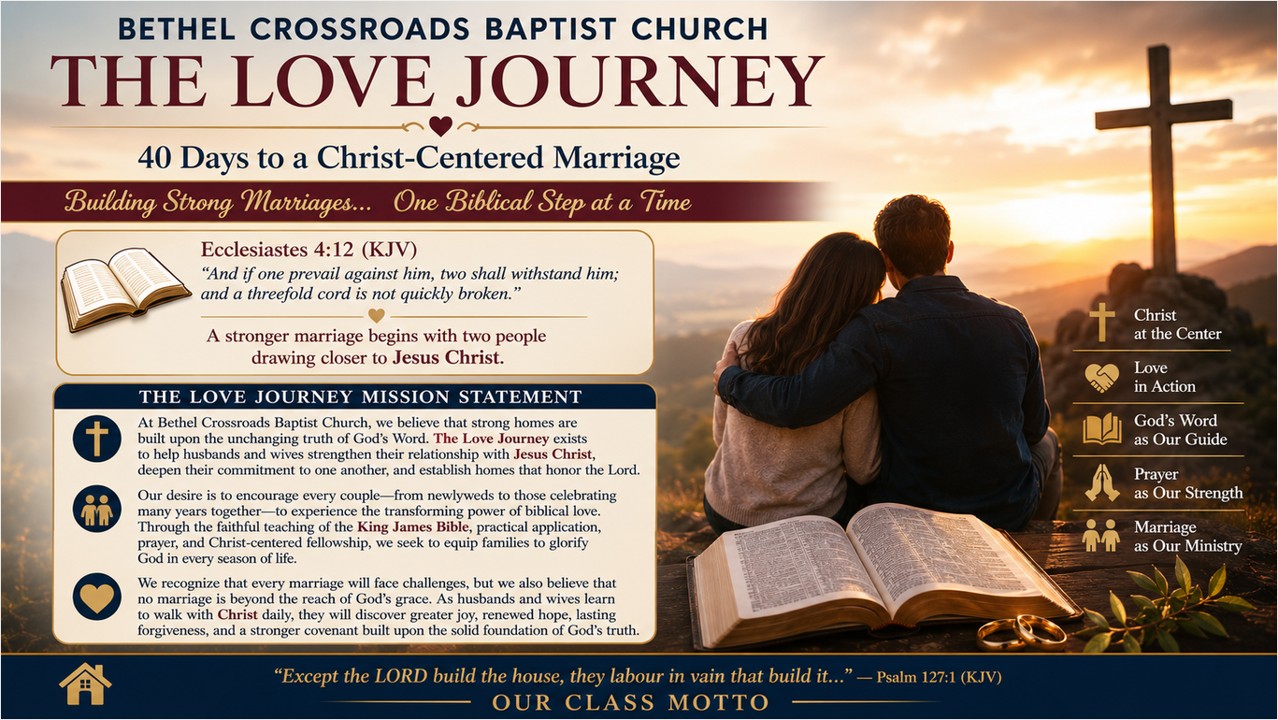
Forty-Day Journey
Days 15 – 21
Honor, Prayer, Intimacy, Understanding, Dependence on God, Christ-Centered Love, Satisfaction in God
15. Love Is Honorable
16. Love Intercedes
17.Love Promotes Intimacy
18. Love Seeks to Understand
19. Love Is Impossible
20. Love Is Jesus Christ
21. Love Is Satisfied in God
SESSION 3 – SEPTEMBER 16, 2026
BUILDING CONNECTION: COMMUNICATION AND RESPECT
Strong relationships are built one conversation at a time.
Main Points:
- Healthy Communication Builds Strong Relationships
- Listening Is an Act of Love
- Respect Is Love in Action
Those three points are easy to remember, easy to teach, and easy for your class to apply throughout the week as they work through Days 15–21 of The Love Dare.
Remember the six major lessons:
- Patience and Kindness
- Selfishness and Anger
- Communication and Respect
- Commitment and Sacrifice
- Forgiveness and Grace
- Living the Love Dare Daily
A great final takeaway is:
“The Love Dare is not about becoming a better spouse, friend, or family member first—it is about becoming more like Jesus Christ.”
Introduction
Someone once said:
“People do not drift into strong relationships—they build them.”
One of the greatest gifts God has given us is the ability to communicate.
Unfortunately, communication is also one of the greatest sources of misunderstanding, hurt feelings, and conflict.
Many relationships do not fail because people stop loving one another. They fail because people stop listening, stop encouraging, and stop respecting one another.
Tonight, we will learn how biblical communication and genuine respect can strengthen every relationship.
Scripture Reading
Proverbs 15:1 KJV
“A soft answer turneth away wrath: but grievous words stir up anger.”
Ephesians 4:29 KJV
“Let no corrupt communication proceed out of your mouth, but that which is good to the use of edifying, that it may minister grace unto the hearers.”
I. HEALTHY COMMUNICATION BUILDS STRONG RELATIONSHIPS
A. Words Have Great Power
Words can:
- Encourage or discourage
- Heal or hurt
- Build up or tear down
Many wounds come from careless words.
B. Tone Matters
Proverbs 15:1 reminds us that a soft answer can calm a difficult situation.
Often it is not only what we say, but how we say it.
C. Speak to Help, Not Harm
Paul tells believers to use words that “edify” or build up.
Before speaking, ask:
- Is it true?
- Is it helpful?
- Is it necessary?
- Is it loving?
Can you remember a time when someone’s words encouraged you during a difficult season?
A Gentle Answer Changes Everything
Proverbs 15:1 (KJV)
“A soft answer turneth away wrath: but grievous words stir up anger.”
Introduction
Have you ever noticed how quickly one conversation can change the atmosphere of a home? One harsh sentence can turn a peaceful evening into an argument. On the other hand, one gentle response can calm a tense situation before it grows into something much bigger.
God reminds us that we cannot always control what is said to us, but we can control how we respond. In marriage, our response often determines the direction of the conversation.
A gentle answer is not a sign of weakness—it is evidence of God’s strength at work in our hearts.
I. A Gentle Answer Brings Peace
“A soft answer turneth away wrath…”
A “soft answer” is not timid or dishonest. It is a response spoken with love, respect, and self-control.
When emotions are high, our natural tendency is to defend ourselves or strike back. But God’s way is different.
A gentle answer says:
- “Let’s talk about this.”
- “Help me understand.”
- “I’m listening.”
- “I’m sorry.”
- “Let’s pray before we say something we’ll regret.”
A calm spirit can stop an argument before it begins.
Marriage Principle:
The volume of your voice does not determine the strength of your message. Love speaks firmly, but gently.
II. Harsh Words Create Greater Hurt
“…but grievous words stir up anger.”
Harsh words are like pouring gasoline on a fire. Instead of solving the problem, they make it worse.
Grievous words include:
- Yelling.
- Sarcasm meant to wound.
- Insults and name-calling.
- Bringing up past mistakes.
- Speaking in anger without thinking.
Once spoken, words cannot be taken back.
The Bible reminds us that we are responsible not only for what we say, but how we say it.
Marriage Principle:
Winning an argument is never worth losing your spouse’s trust.
III. Christ Is Our Perfect Example
Jesus faced criticism, rejection, and false accusations, yet He responded with truth, grace, and love.
When we allow Christ to rule our hearts, His Spirit helps us respond differently.
Instead of reacting in the flesh, we learn to answer in the Spirit.
Before speaking, ask yourself:
- Will these words honor Christ?
- Will they help my spouse?
- Will they bring peace or create more pain?
When Jesus controls our hearts, He also controls our tongues.
Marriage Principle:
A Christ-filled heart produces Christ-like words.
Love Dare Challenge
Today, make this commitment:
Before you answer your spouse, pause and pray.
Ask the Lord to help you speak with gentleness, even if the conversation is difficult.
Look for one opportunity today to replace a sharp response with a soft answer.
You may be surprised how one gentle reply changes the entire atmosphere of your home.
Memory Thought
“A gentle answer may only take a moment to speak, but it can bring peace that lasts far longer than the argument it prevented.”
II. LISTENING WITH UNDERSTANDING
A. Listening Is an Act of Love
Many people listen only long enough to prepare their response.
Godly love listens to understand.
B. Good Listeners Value Others
Listening says:
- “You matter.”
- “I care.”
- “What you are saying is important.”
C. Jesus Listened to People
Throughout the Gospels, Jesus listened carefully before responding.
He understood people’s hearts as well as their words.
What are some obstacles that keep us from listening well?
III. SHOWING RESPECT THROUGH WORDS AND ACTIONS
A. Respect Is More Than Good Manners
Respect recognizes the value God has placed on another person.
B. Respect Is Seen in Everyday Actions
Respect is shown by:
- Keeping promises
- Being considerate
- Speaking kindly
- Showing appreciation
C. Respect Strengthens Relationships
People thrive where respect is present.
Relationships weaken where respect is absent.
Words That Build, Not Break
Ephesians 4:29 (KJV)
“Let no corrupt communication proceed out of your mouth, but that which is good to the use of edifying, that it may minister grace unto the hearers.”
Introduction
One of the greatest gifts God has given us is the ability to speak. With our words we can encourage, comfort, teach, and express love. Yet with those same words, we can also wound, discourage, and tear down.
In marriage, words matter. Long after flowers fade and gifts are forgotten, loving words continue to strengthen a relationship. Likewise, careless words can leave scars that last for years.
Paul reminds us that every conversation should be an opportunity to build up our spouse and reflect the grace of Christ.
I. Refuse Words That Tear Down
“Let no corrupt communication proceed out of your mouth…”
The word “corrupt” means rotten, harmful, or unwholesome. Just as rotten fruit is unfit to eat, rotten words are unfit for a Christian’s mouth.
Corrupt communication includes:
- Harsh criticism.
- Insults and name-calling.
- Sarcasm meant to hurt.
- Yelling in anger.
- Gossip or speaking behind your spouse’s back.
- Bringing up past failures to win an argument.
Once words are spoken, they cannot be taken back. They may be forgiven, but they are often remembered.
Marriage Principle:
Before you speak, ask yourself, “Will these words heal or hurt?”
II. Choose Words That Build Up
“…but that which is good to the use of edifying…”
The word “edifying” means to build up.
Think of a builder constructing a house. One brick at a time, the house becomes stronger. In the same way, every encouraging word strengthens your marriage.
Build your spouse with words like:
- “Thank you.”
- “I appreciate you.”
- “I’m proud of you.”
- “I’m praying for you.”
- “I love you.”
Simple words spoken sincerely can change the atmosphere of an entire home.
Marriage Principle:
Your spouse should leave a conversation with you feeling stronger, not smaller.
III. Speak Words That Give Grace
“…that it may minister grace unto the hearers.”
Grace is receiving kindness we do not deserve.
Every conversation is an opportunity to reflect the grace Christ has shown us.
When your spouse makes a mistake, respond with grace.
When they are discouraged, speak hope.
When they succeed, celebrate them.
When they fail, encourage them to keep going.
Jesus never used His words to crush people who came to Him in humility. He spoke truth with love, compassion, and grace. As His followers, our words should do the same.
Marriage Principle:
The tone of your voice often communicates as much as the words you speak.
Three Truths for Marriage
1. Love Thinks Before It Speaks.
A moment of patience can prevent years of regret.
2. Love Uses Words to Strengthen, Not to Win.
The goal is not to win an argument but to build a stronger relationship.
3. Love Reflects the Grace of Christ.
When your words are filled with grace, your home becomes a place of encouragement, healing, and peace.
Love Dare Challenge
Today, make it your goal to speak five encouraging statements to your spouse.
They don’t have to be long. They simply need to be genuine.
Examples:
- “Thank you for all you do.”
- “I appreciate your hard work.”
- “I’m thankful God gave me you.”
- “You handled that well.”
- “I’m praying for you today.”
Watch how intentional words of encouragement can brighten your spouse’s day and strengthen your marriage.
“The strongest marriages are built one encouraging word at a time. Let every word you speak become a gift of grace to the one you love.”
What is one practical way you can show respect to someone this week?
The mouth reveals what is in the heart.
When the heart is yielded to Christ, the Holy Spirit helps us speak words filled with grace and truth.
Many relationship problems are not communication problems—they are heart problems.
When Christ changes the heart, He changes the words.
The closer we walk with Jesus, the more our speech reflects His character.
Application
Ask yourself:
1. Are my words building people up or tearing them down?
Answer: God wants our words to encourage and strengthen others.
2. Do I truly listen to understand others?
Answer: Listening is one of the greatest expressions of love.
3. Am I showing respect in both my words and actions?
Answer: Respect communicates value and honor.
Challenge Questions
1. What kind of words am I known for speaking?
Answer: Our words reveal the condition of our hearts.
2. Am I listening more than I am talking?
Answer: Wise people learn to listen carefully.
3. How can I better show respect this week?
Answer: Through kindness, appreciation, and thoughtful actions.
Assignment for Next Session
Complete Love Dare Days 15–21.
As you complete each day’s challenge:
- Record what God teaches you.
- Notice changes in your conversations.
- Practice listening before responding.
- Look for opportunities to encourage others.
Come prepared to share one way God helped you improve communication during the week.
In Christ,
Darrell
