
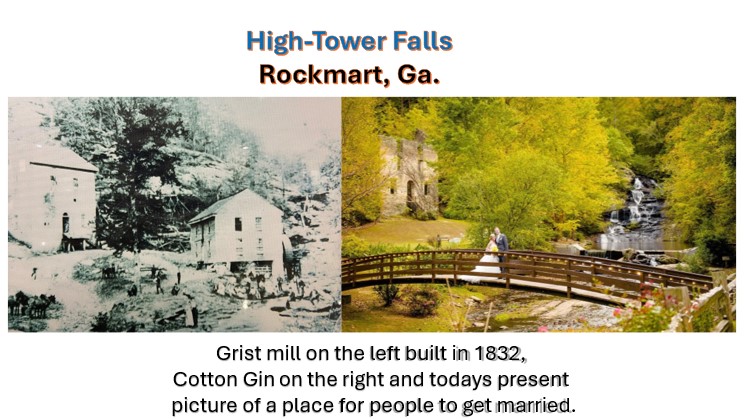
Long before High-Tower Falls became a place where brides walk in white and vows are spoken beneath open skies, it was a place of work, water, and waiting.
In 1832, High-Tower Falls stood as a vital artery of life along the river. On one side of the rushing water rose a grist mill, its great stone wheels turning day and night. On the other stood a cotton gin, both buildings anchored by the same river and the same relentless waterfall—power drawn straight from God’s creation.
Families traveled for miles, bringing corn and wheat by wagon and horseback, trusting that what they carried would be transformed. Grain went in rough and unrefined; flour came out ready to sustain homes. That was the purpose of the mill: to take what was given and make it useful, lasting, and nourishing.
And today—nearly 200 years later—this same ground still transforms what is brought to it.
Now couples arrive not with sacks of grain, but with hopes, promises, and hearts. The roar of the falls still echoes. The river still flows. And once again, something sacred is being made.
“Unless the Lord builds the house, those who build it labor in vain.” Psalm 127:1
Marriage, like milling grain, is not instant. It requires commitment, pressure, endurance, and time. What enters raw must be refined. What is divided must be made whole. The water that once turned stone wheels now bears witness to covenant vows.
“Therefore, what God has joined together, let no one separate.” Mark 10:9
Just as farmers trusted the mill with their harvest, marriage calls couples to trust God with their future. To stay when it’s hard. To wait when progress feels slow. To believe that love—worked faithfully—will sustain generations.
High-Tower Falls reminds us that this land has always been about provision and promise. Once it fed bodies. Now it strengthens families. Once it ground grain. Now it forges covenant.
“Two are better than one… A cord of three strands is not quickly broken.” Ecclesiastes 4:9–12
To those who stand here today:
May you honor marriage not as a moment, but as a lifelong calling.
May you grind through trials together.
May your union be built strong, like the mills that once stood firm against the river.
From 1832 to 2025, the purpose remains the same:
Bring what you have.
Trust the process.
Let God make it lasting.
In Christ,
Darrell
In the early 1800s, Georgia was scattered with hundreds of grist mills. Historians estimate that nearly every settled region—and the majority of Georgia’s counties—had at least one mill by the mid-19th century. Before modern roads and factories, mills like High-Tower Falls were community centers. People waited together. Stories were shared. Labor was honored. Patience was required.
